- Eiko's Newsletter
- Posts
- Tiniest of Time Capsules: Seeds, Raisins, Making Your Own Capsules
Tiniest of Time Capsules: Seeds, Raisins, Making Your Own Capsules

Eiko Mizushima
August 13, 2025

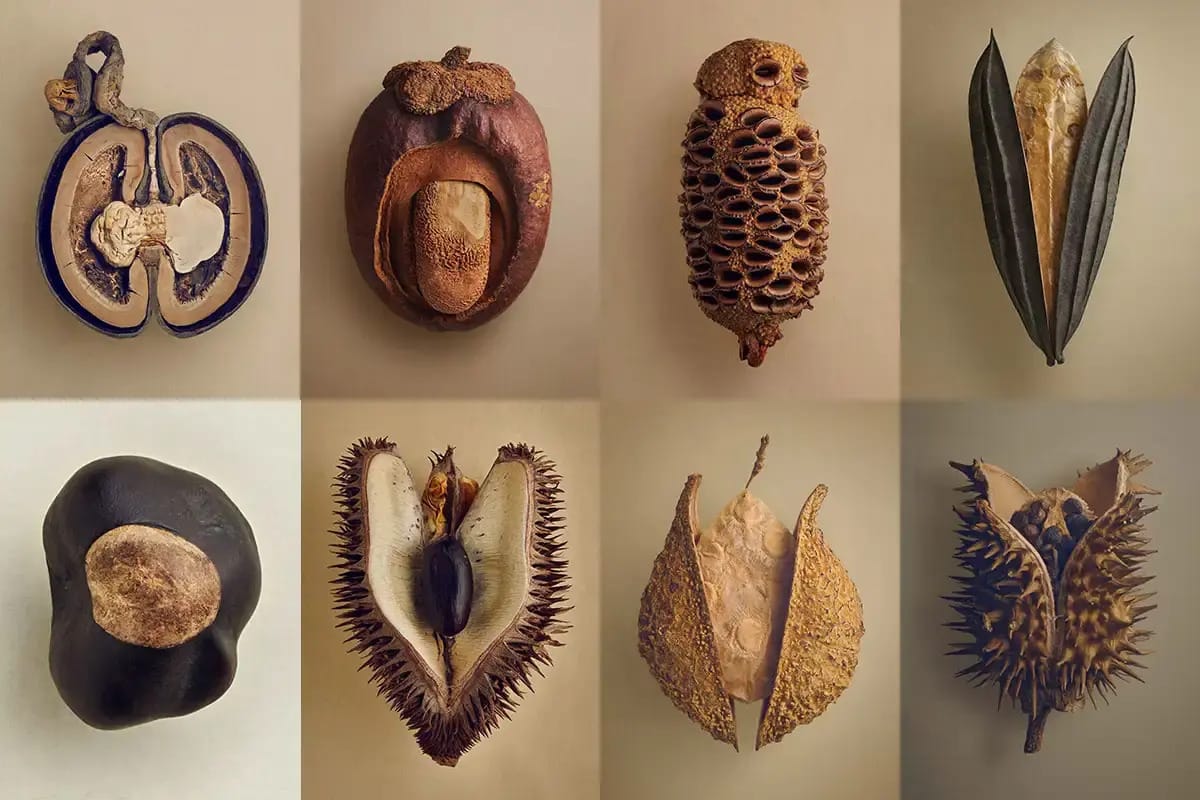
Photo by Levon Bliss
Song of the Week
Listen to this song as you read to help open you up. Remembrance by Anju.
Updates!
For this week I am sharing about small things that hold a lot— raisins, seeds, and time capsules. While doing some of my research on the raisin meditation, I also found myself thinking a lot about grapes. Fun fact that might add more depth to your raisin meditation, grapes are believed to have originated in the central and western Eurasia about 400,000 years ago. So cool.
*Also I wanted to make a correction from last week, Prentis Hemphill uses they/them pronouns.
The Raisin Meditation
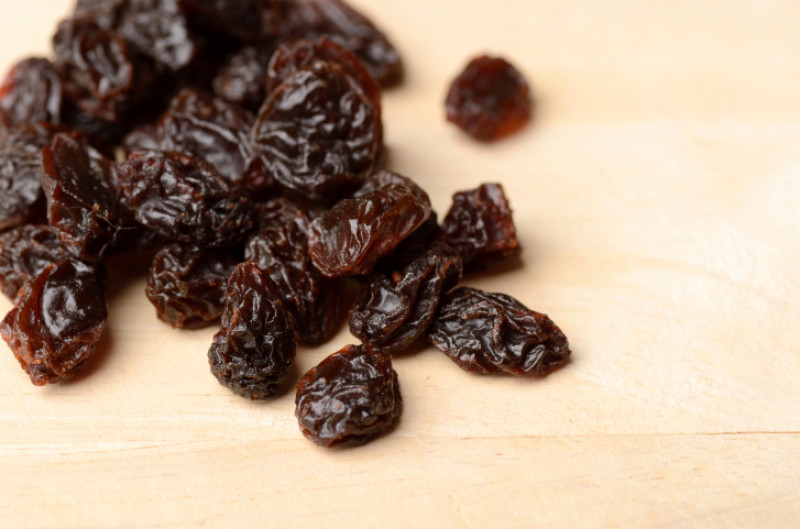
The raisin meditation controversy. Does it work? Do you like raisins? Is it more fun with chocolate? With your favorite food? Probably. A short story from my college days. A past girlfriend of mine’s mother tried to bring her four mangos from India. It was peak mango season there, my girlfriend was graduating from college, and feeling sad that she was missing peak mango season. Her mom tried to sneak them past TSA, but unfortunately she was caught, and fined $200. Per mango! It turned into a $800 graduation gift, snatched by TSA, and likely enjoyed in the break room. We can only hope. This stirs all sorts of feelings in me, but mostly, I think begrudgingly how good those mangos would have tasted! Touched by a mother’s ferocious connection to land and season, dedication to daughter, and the seditious act of smuggling fruit through TSA. Nowadays I can taste some of that flavor every time I eat a great mango, which I did yesterday.
The main point is that for many people, expanding positive experiences in the body, by paying attention to sensations, pays off. There are so many ways to do this, and mindfully eating food is just one. Expansion of sensation can be done through group ceremonies, singing, drumming, dancing, swimming, protesting, if it feels good and you have a body, it applies.
Reading through the evidence of the cultural efficacy of the raisin meditation which I share below, was pretty interesting and did make me laugh and sigh occasionally. That it didn’t work great with men who were living in incredibly harmful circumstances (incarcerated) or in more collectivist cultures with greater aversion towards individualized and secular stress reduction practices? I’m not surprised about that.
I’m grateful that not every stress reduction technique works universally. It speaks to how beautifully unique and specific culturally-grounded practices are. Thank goodness every experience can’t be recreated into every body, in any land. It’s also heartbreaking to know exactly why giving incarcerated men mindfulness raisins didn’t help. It’s a nice thought, but of course we need bigger and bolder ways to remedy that.
Given the lives that most people reading this lead, I think a food meditation would work well. Slow down today, be with a favored food, or a sensation that reminds you of a people, place , or a thing worth savoring, or perhaps, worth sneaking through TSA.
Time Required
Five minutes daily for at least a week.
How to Do It
Holding: First, take a raisin and hold it in the palm of your hand or between your finger and thumb. Imagine that you’ve just dropped in from Mars and have never seen an object like this before in your life.
Seeing: Take time to really focus on it; gaze at the raisin with care and full attention. Let your eyes explore every part of it. Examine the highlights where the light shines, the darker hollows, the folds and ridges, and any uneven parts or unique features.
Touching: Turn the raisin over between your fingers, exploring its texture. Try doing this with your eyes closed if that enhances your sense of touch.
Smelling: Hold the raisin beneath your nose. With each breath in, take in any smell, aroma, or fragrance that may arise. As you do this, notice anything interesting that may be happening in your mouth or stomach.
Placing: Now slowly bring the raisin up to your lips, noticing how your hand and arm know exactly how and where to position it. Gently place the raisin in your mouth; without chewing, noticing how it gets into your mouth in the first place. Spend a few moments focusing on the sensations of having it in your mouth, exploring it with your tongue.
Tasting: When you are ready, prepare to chew the raisin, noticing how and where it needs to be for chewing. Then, very consciously, take one or two bites into it and notice what happens in the aftermath. Place close attention to any waves of taste that come from it as you continue chewing. Without swallowing yet, notice the bare sensations of taste and texture in your mouth and how these may change over time, moment by moment. Also pay attention to any changes in the raisin itself.
Swallowing: When you feel ready to swallow the raisin, see if you can first notice the urge to swallow as it comes up, so that even this is experienced consciously before you actually swallow the raisin.
Following: Finally, see if you can feel what is left of the raisin moving down into your stomach, and sense how your body as a whole is feeling after you have completed this exercise.
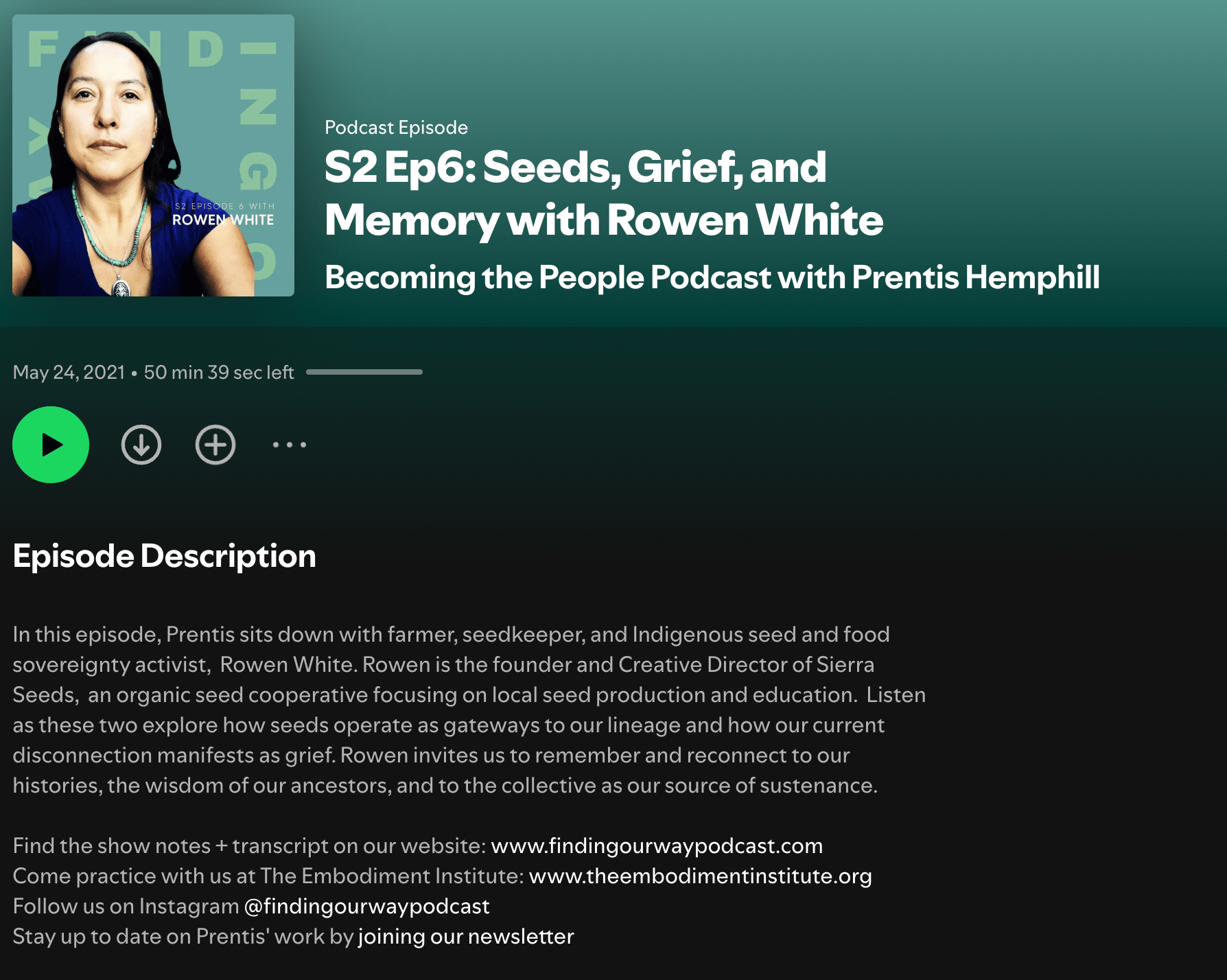
Food for Thought From Podcast:
What are the standards for your own life that are not externally dictated?
What does a good life mean to you, as opposed to what capitalism tells you is a good life?
Who are the foods that fed my ancestors?
Listen to the divine essence that animates you. The infinite immensities, as Rowan White describes the ability of seeds to hold and transcribe matrixes of infinite cosmologies and relationships we need to remember the miracles of life.

Creating time capsules, can bring up a lot of feelings of grief, also purpose, which is one of the reasons why I recommend doing this activity with loved ones. Think about if you want it to biodegrade or not. Check out how serious the National Archives of Australia took this idea. Things to think about include:
Who is your proposed audience?
What do you want to say?
Where will the capsule be placed when closed?
When will the capsule be opened?
Container options:
Copper alloy or high alloy stainless steel are suitable capsule materials for long-term burial. Ideally, the container should be of seamless or welded construction with a screw top and gasket. Avoid the use of soft lead solder as this will deteriorate faster than the rest of the capsule.
Suitable capsule materials for short term burial are high-density polyethylene tubing, Pyrex-type, (borosilicate) glass or brass.
A secondary container is a practical way of providing a moisture barrier and buffering both capsule and its contents from environmental changes.
Schedule With Me! I love Referrals From You.

OTR/L, BA, MHP, LMT,
she/they) Integrative Therapies
I with individuals, couples, and offer trauma informed somatic therapy, craniosacral therapy, Swedish massage, Thai bodywork, myofascial release, group workshops, and healing through art, play, and connecting to nature. Free 15 minute consultations can be booked on my website if you’re intrigued or have questions. I’ve been getting more referrals from you all, THANK YOU! It’s fun to see everyone’s relationship matrixes.
Community Events