- Eiko's Newsletter
- Posts
- A Beautiful Thing Is Never Perfect
A Beautiful Thing Is Never Perfect

Eiko Mizushima
November 14, 2025
Song of the Week
Listen to this song as you read to help open you up. Amhrán Mhuínse by Ceara Conway. "Amhran Mhuinse" is a traditional Irish sean-nós lament, a "farewell from the deathbed". The song is sung from the perspective of an old woman on her deathbed, wishing to be buried in her native island. It is a song about the longing for home and roots.

My cup, on one of my favorite stumps. Photo by Eiko Mizushima.
Updates!
This week I’m thinking about imperfection. When I was in Japan a few years ago I spent an evening with a friend from college, who had moved back to Japan, and her ceramics buddies. The group on average was about 70 years old, and mostly women from the small village she lived in. They were staying up all night to feed wood into the hungry community kiln. After twenty pairs of eyes watched me eat a delicious potluck meal, very closely, I was complimented on my chopstick skills, and we shifted into conversation about ceramics. An older man seemed to like that I was trying to re-learn Japanese art and culture, and gifted me two copper-red-brown sake cups he made. He cringed as he told me how ceramics in the U.S. were UGLY because they were too perfect. He asked me, “Where are the traces of the human spirit?” Which is to say—where are the mistakes? Where are the flaws that make us beautiful?
His ceramics, were the shape of his beautiful hands. A little asymmetrical, with deep lines his fingers made. I think of his hands when I drink from my cup. They were working hands, calloused, solid, and leathery from the sun. I like touching his imprints, his honesty, pride, his stubbornness, and care. I couldn’t agree more, the cup is so beautiful because of it, his, our human imperfections.
Wabi sabi is a Japanese concept about transience and imperfection "imperfect, impermanent, and incomplete" they say. I mean that’s what life is about right? At the core. Yet, imperfect, impermanent, and incomplete often feels incredibly distressing for most people I know, myself included. There is an Egyptian proverb, “A beautiful thing is never perfect.” There are so many proverbs around the world that send the same message.
A few weeks ago I took an intelligence test, and it was stressful. When I got my results I asked about a test I thought I flunked and what it was measuring. Good to know what I’m bad at, right?
“That’s the test you scored best in, by a long shot,” my test administrator said. By far the test I scored best in, was the one I thought I failed! The one I thought I did pretty well in, I didn’t do great in. Fascinating. When in distress, most of us think we’re failing, but the irony is that distress tends to help us do better if it’s titrated. When something feels easy, we assume we’re succeeding.
In the plant world there is something called thigmomophogenesis. For some reason I imagine that guy from South Park saying this word, to make fun of scientists. Anyways, this comes from the Latin words for “touch” + “appearance” + “beginning” and speaks to how plants that experience wind, stress, and shaking grow more resilient roots, thicker stems. I love when you can so clearly see how culture is born from the land. Experiencing discomfort, and the ability to reach for, accept imperfection, as a positive attribute also leads to lower levels of cortisol (stress hormone often measured in stress studies, thank you science) and is considered the ideal zone for learning when it’s experienced in the right amount. The right amount usually means that the stress doesn’t turn you into a big puddle on the floor, if that’s happening, get help from a loved one or trusted person.
For this week, I hope we all can find clarity in the ways our stress leads to growth, get help if your stressors are not leading to growth, and get back up again, because we only have so many days on this earth to get back up. This seems like a time-tested way to enjoy the inherent imperfections of life, and make our movements and our moves to make the world better, more resilient and more possible too.
I’ll leave you with this Japanese proverb. ななころびやおき Fall seven times, get up eight. Go on then.
Schedule With Me! Taking Referrals!

OTR/L, BA, MHP, LMT,
she/they) Integrative Therapies
I offer trauma informed somatic experiencing therapy for trauma re-negotiation/resolution (individual and couple), craniosacral therapy, Swedish massage, Thai bodywork, myofascial release, group workshops, and healing through art, play, and connecting to nature. Free 15 minute consultations can be booked on my website if you’re intrigued or have questions.
People’s Fund 2025 Is Open
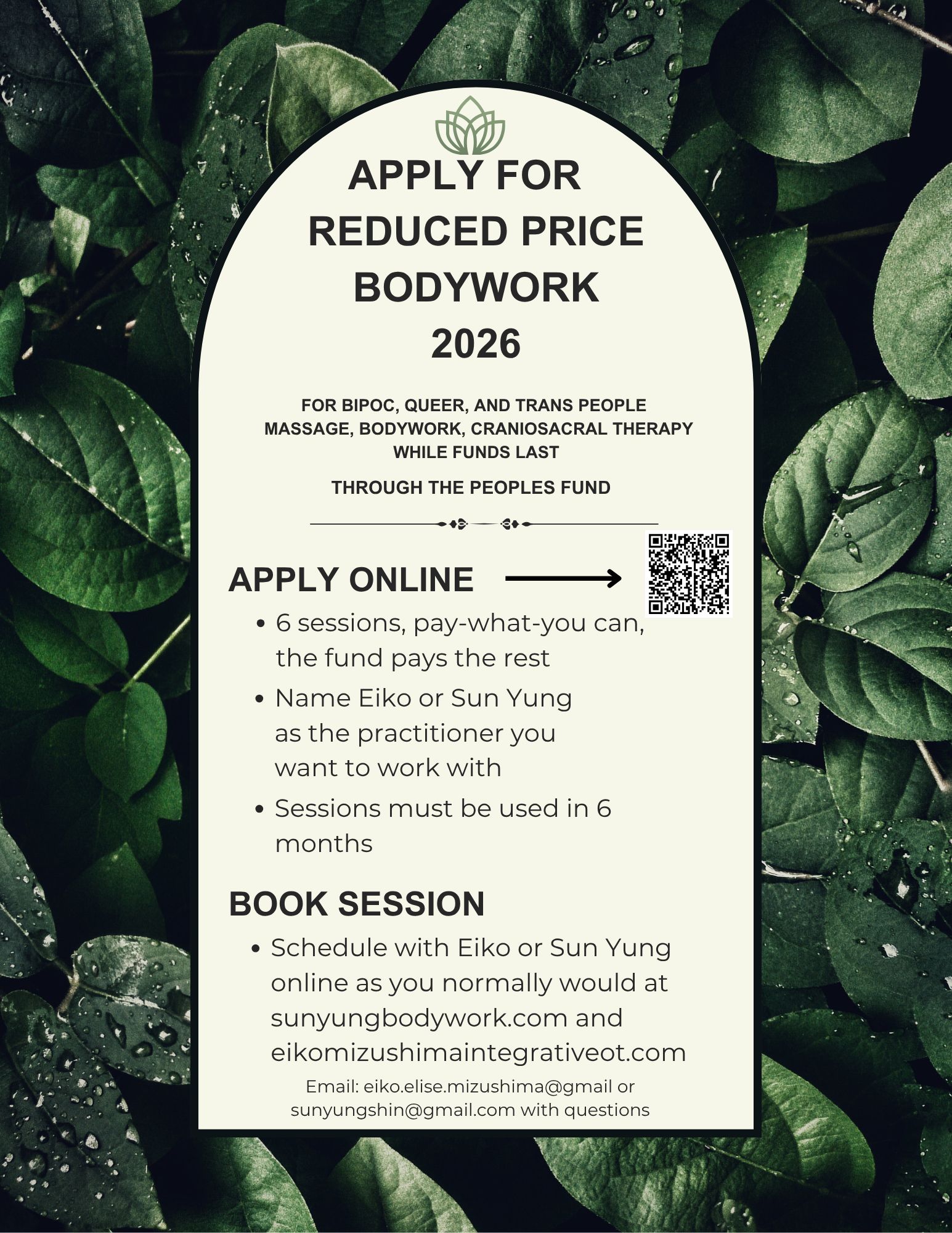
If you know folks who want to see Sun Yung Shin or I but cannot afford our regular prices, the People’s Fund is open for this year. It operates on a first come first serve basis, people pay what they can and the fund kicks in the rest. Folks can use this for somatic experiencing, OT, or bodywork with me.
Just For Fun
Community Events